
Historically and culturally France is among one of the most important nations in the Western world, having played a highly significant role in historic international affairs, with former colonies in every corner of the globe. Bounded by the Atlantic Ocean and the Mediterranean Sea, the Alps and Pyrenees, France is the geographic, economic and linguistic bridge joining Northern and Southern Europe.
France is the largest country in Europe and one of the most diverse – with German influences along the northern border, Spanish notions in the south and Italian elements from Nice to Marseille. As one of the oldest nations globally, France's landmarks, fashion, film and culture are deeply influenced by the country's long-standing history.
France's major cities and provinces are bursting with life and activity, from the vibrant riverside cafes and restaurants on the Seine River in Paris to Provence's quaint medieval artists' villages and sun-drenched seaports, the architectural grandeur and political history of the Palace of Versailles, and the winter wonderland of powdery snow in the French Alps. There is so much more to France than the traditional tourist destinations, with multiple film, food and cultural festivals and destinations of natural beauty.

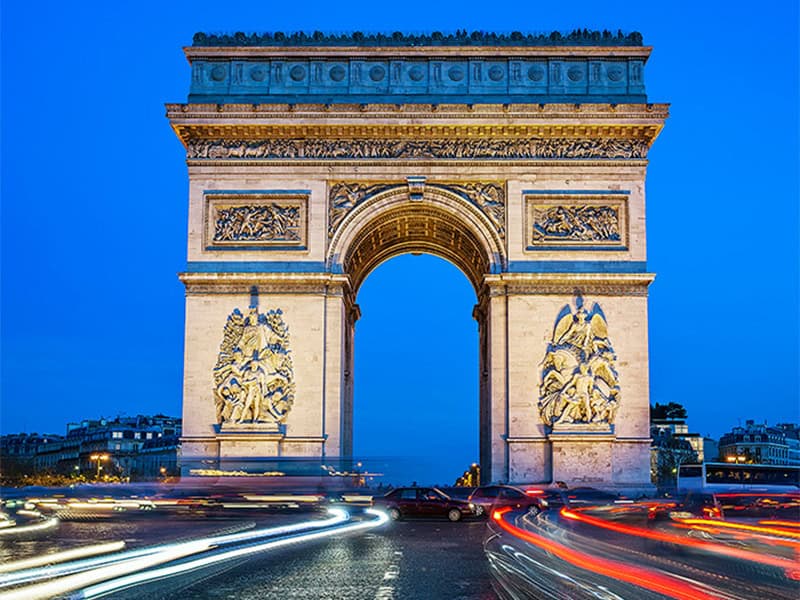
Explore the glorious French countryside and its landmarks with dramatic scenery, hiking and alpine sports in the Chamonix Valley, a jaunt along the French Riviera coastline, a journey to the quaint canals and rich history of Bruges or a day trip to the UNESCO listed island of Mont Saint-Michel. Delve into the history of the Lascaux Caves, admire the Monet Garden in Giverny, visit the Champagne province just east of Paris to learn about the rich history of Champagne or visit the expansive purple lavender fields in The Valensole Plateau.
Go sailing in Saint-Tropez on the Mediterranean, attend the Cannes Film Festival, watch the sunset behind the Eiffel Tower and the lights sparkle every hour or shop in the upmarket French department store of Galerie Lafayette. And, if all that activity makes you hungry, there's plenty to choose from; from Michelin star restaurants to Croque Monsieur in street-side cafes, boeuf bourguignon, escargot, and steak tartare. Dig into a traditional onion and beef stock soup of Soupe à l'oignon, help yourself to a macaron or fresh pastry, enjoy a soufflé or sit down to an array of fresh French cheeses and meats.




At OSS World Wide Movers, our network of FIDI / FAIM accredited partners cover the whole of France.
Our partners in France are well versed in all aspects of the requirements for importation of personal and household goods.
This guarantees you a seamless, tailor made move to France, right through to your new home not only your personal effects and vehicles, but also for your much loved pets as well.

When moving your household goods to France by sea freight, this will typically take 10 – 12 weeks for an FCL service. For services such as LCL and shared container services (i.e. groupage), these will take longer to reach your destination as your goods will need to be consolidated with other consignments heading to the same destination. Please discuss these options & shipping times with your removal consultant, as shipping times will vary greatly for each destination when using this type of service over an FCL service.

If you are sending items that have been packed by yourself, "Packed by Owner", then they will attract a more stringent inspection by Customs on arrival in France. Providing a detailed carton-by-carton inventory will assist Customs in inspecting your effects and may avoid unnecessary delays.
It is advisable to have your goods packed by OSS if you are looking at sending larger consignments, to ensure the clearance process can be conducted with a minimum of fuss.

Moving motor vehicles and motorbikes when moving to France is possible provided Customs criteria are met.
The service we provide is usually a depot to depot service, meaning the motor vehicle will need to be collected by you from our partner's depot in France following customs clearance. Customs may require evidence that the owner of the vehicle has lived abroad for 12 months or longer, so a copy of your passport with a date stamp showing arrival in France, or a copy of the lease or rental agreement in France would be sufficient. For in-depth detail about these requirements, click here.

OSS offers a full range of moving insurance options depending on your needs. Although your shipment to France will be packed to export standards (designed to withstand the longest journey), the small cost of insurance gives you complete peace of mind with regard to the exposure and rigours inherent in moving from one side of the world to the other.
Ask us about MoveCover, and our Marine Transit Insurance product to cover those risks that are unforeseen in every move.

Moving overseas with your pets presents a unique set of logistical challenges. When moving with your loved pet, eg Cat or Dog, this process will be managed with a specialist 'OSS approved' pet moving provider who understands the needs of both pets and their owners, and will take care of all the relevant arrangements for your move to France.
Pets that are imported from non-EU countries must be declared and presented to Customs for document and identity checks before they can be allowed into the territory of the European Union. Importing an undeclared animal can result in a fine and confiscation of the animal.
Only the following animals accompanying a traveller are considered pets within the meaning of veterinary regulations and as such are tolerated under the conditions set out below:
Please note there is a ban on importing certain attack dogs into France. The dogs concerned are Category 1 dogs without a pedigree recognised by the French Ministry of Agriculture belonging to the following breeds: Staffordshire terrier, American Staffordshire terrier (pitbull), Mastiff (boerbull) and Tosa.
For more information about taking your pets with you to France, click here.

If you are considering a move to France then it's very important that you understand the vast tax differences between the two nations. The taxes in France are extensive. In fact, as someone who lives in or makes money from France, you may pay taxes on the following things, among others:
You are liable to pay taxes in France if:
You also need to note that VAT is taxable on certain goods and services and will be included in the sales price of the relevant items. The standard rate of VAT in France is currently 20%. However, you should note there are reduced French VAT rates for certain pharmaceuticals, public transport, hotels, restaurants, and tickets to sporting/cultural events (10%); food and books (5.5%); and TV licenses and newspapers (2.1%).
The personal income tax rates for non-residents – Non-residents usually pay tax on their France-sourced income at a minimum French tax rate of 20% for French-sourced income up to €27,519 and 30% for income above this threshold. If you don't plan to use an accountant, be sure to do your research thoroughly so that you don't end up facing fines or penalties. Please note that this information is general in nature and not specific to your circumstances.
It is vital that you understand and obtain specific accounting and taxation advice suitable to your individual circumstances prior to your arrival.

When looking to relocate to France you will need to consider the extensive list of restricted and prohibited items. The following is a sample of the extensive list you can see via this PDF: Moving to France – FIDI Guide
Prohibited items
Restricted items
For an extensive listing please refer to the EU Customs Tariff (TARIC) page by clicking here.

Moving to France with a boat is similar in the requirements to moving a vehicle to France, when it comes to the registration requirements and process. Customs and Quarantine in France will have a special interest in the boat due to its exposure to marine life, however as Australia has a fairly clean marine environment, your boat should pass customs and quarantine without any problem. For more information about the entry requirements, click the link here.

For France, there are two associated plug types, types C and E. Plug type C is the standard European plug which has two round pins and plug type E is the plug that has two round pins and a hole for the socket's male earthing pin. The C type plug also fit in a type E outlet. France operates on a 230V supply voltage and 50Hz. You can use all your equipment in France if the outlet voltage in your own country is between 220V-240V. This is the case in most of Europe, Australia, the United Kingdom and most countries in Africa and Asia.


Contact the Embassy of France by visiting:
6 Perth Avenue
YARRALUMLA
CANBERRA ACT 2600
Australia
Phone: +612 6216 0100
Fax: +612 6216 0132
Email: information.canberra-amba@diplomatie.gouv.fr
Embassy website: http://www.ambafrance-au.org/-English-
Please contact the Consulate-General of France in Sydney by visiting:
Level 26, St Martins Tower
31 Market Street
SYDNEY NSW 2000
Australia
Phone: +612 9268 2400
Fax: +612 9268 2431
General Visa Information can be found here: https://au.ambafrance.org/-Visas-new-
Follow this link for immigration information and related services: http://www.diplomatie.gouv.fr/en/coming-to-france/
Facebook Page: https://www.facebook.com/Ambafrancecanberra
Twitter Page: https://www.twitter.com/FranceAustralia
Capital (and largest city): Paris
Official Language (and national language): French
Nationality (2018): 93% French, 7% Others
Religion (2020): 58.1% Christianity, 31.9% No Religioon, 8.3% Islam, 0.7% Others
Demonym(s): French
Government: Unitary Semi-Presidential Republic – President Emmanual Macron, Prime Minister Jean Castex
Area: 640,679 km squared
Population (May 2021 estimate): 67,413,000
Currency: Euro (EUR)
Time Zone: UTC +1 (Central European Time) & UTC +2 (Central European Summer Time)
Driving Side: Right
Calling Code: +33
When many people think of French culture they often think of Paris… but that could be a 'débutant' mistake. As life outside of the City of Lights is very different to that of the capital and certainly varies from region to region. That said France is know as a hub of sorts for fashion, cuisine, art and architecture.
France is much larger than many people realise! Stretching 1,000km from north to south and the same from east to west, it's the third largest country in Europe after Russia and Ukraine, covering an area of 551,500km²
Metropolitan France has four coastlines – the North Sea, the English Channel, the Atlantic Ocean and the Mediterranean Sea – with a combined coastline length of 3,427km. With the exception of its north-eastern border, the country is bounded either by water or by mountains – namely the Rhine and Jura, the Alps and the Pyrenees.
Outside metropolitan France, the national territory extends to the 'départements d'outre-mer' and 'territoires d'outre-mer', collectively referred to as 'DOM-TOMs'. These are French Guiana in South America; the islands of Guadeloupe, Martinique, Saint-Barthélemy and Saint-Martin in the Caribbean; the islands of Réunion and Mayotte off the coast of Africa; Saint-Pierre and Miquelon south-east of Canada; and French Polynesia, New Caledonia and Wallis and Futuna in the South Pacific. With the inclusion of these overseas territories, France's total land area rises to 675,417km².
France's climate is temperate, but divided into four distinct climatic areas. The oceanic climate of western France brings average rainfall spread over many days, and modest annual temperature variations (Brittany, Normandy, Atlantic Loire, Loire Valley). Central and eastern France's continental climate harbours cold winters and hot summers (the Champagne region, Burgundy, Alsace). The Mediterranean climate of south-eastern France is responsible for hot, dry summers, with rainfall from October to April (when the weather is damp but mild) and ample sunshine all year round (Provence, Côte d'Azur and Corsica). Above 600-800m altitudes, France's mountain climate brings heavy rainfall, and snow three to six months per year.
While French is the official and dominant language of the country, spoken by the 70+mil residents, you will also find a small percentage of the population speaking German, Flemish, Arabic, Italian, Chinese, Vietnamese, and even Creole and Breton. Migration plays a large part in this and so does the geographic location of these residents, as they may be living close to the borders of neighbouring countries (Spain, Italy, Germany, Switzerland and Belgium).
Nevertheless, when you go, it pays to know some basic French phrases as locals often appreciate the efforts put in by visitors who try to speak their language. Just don't confuse faire la tête (to sulk) with faire la fête (to party)!
There are special days and national celebrations in France almost every month. Some of them are fixed Public Holidays, some are changeable Public Holidays and some are not holidays at all but treated as special days with friends and loved ones, days when traditions are held dear. There are eleven public holidays in France every year and several more days that are honoured and celebrated nationally.
January 1 – Jour de l'An – New Year's Day
New Year's Eve and public holiday New Year's Day are generally celebrated with friends and family.
January 6 – Epiphanie: Fête des Rois – Epiphany: Feast of the Kings
It is a tradition is to serve a special cake called "une galette des rois" which contains une fève (usually a porcelain figurine). The person who finds the hidden fève in their serving is named king or queen for the day and wears the paper crown sold with the galette. This day, held on 6th January, commemorates the visit of the Magi to the Christ Child.
February 2 – La Chandeleur – Candlemas
A day when traditionally crèpes are eaten, believed to have religious origins.
February 14 – La Saint Valentin – Valentine's Day
This is the day for lovers – cards, flowers or small presents are shared with a special person.
April 1 – Poisson d'Avri l – April Fool's Day
Practical jokes mark this day and Poisson d'avril is the expression shared following a successful tease. One explanation for this day is April 1 marks the opening day of fishing season, which was considered a bit of a joke as very few fish were to be caught so early in the season. Like the fishermen of old who attempted to catch the elusive fish, now it is customary to try to catch friends in a joke. Some say that another reason for the term poisson was a corruption of the word "passion" referring to the Easter season.
March or April – Pâques – Easter Sunday
The Christian holiday to celebrate the resurrection of Christ. A special dinner is served with a traditional dinner of lamb and chocolate is customarily given.
March or April – Le lundi de Pâques – Easter Monday
The day following Easter is a public holiday in France and time to eat your chocolate!
May 1 – Fête du Travail – Labor Day and May Day
A national holiday designated as Fête du Travail – International Labor Day. It is also May Day and includes a custom to present un brin de muguet (stem of lilies of the valley) to loved ones to bring them good luck and happiness (porter du bonheur). Read more about the Brin de Muguet.
April or May – Jour de l'Ascension – Ascension Thursday
Held 40 days after Easter to commemorate Christ's ascension to heaven. Note this is a changeable Public Holiday.
May 8 – Jour de la Victoire 1945 – WWII Victory Day 1945
A public holiday which celebrates the end of World War II in Europe.
May or June – Pentecôte – Pentecost Sunday
Held 50 days after Easter in memory of the descent of the Holy Spirit on the Apostles. Note this is a changeable Public Holiday.
May or June – Lundi de Pentecôte – Whit Monday
In 2005, the French Parliament voted to remove this holiday from the official list of public holidays. However, as a response to widespread opposition to the change, some employers retained the day as a holiday for staff. As a compromise, the government designated June 5 as a national school holiday.
May 30 – Fête des Mêres – Mother's Day
The day to celebrate mothers everywhere in France, chocolates and flowers are the main choice for gifts.
May – Nuits des Musées – European Night of Museums
All over France thousands of museums open their doors for one night in an exceptional free opening to the public on the Saturday closest to 18 May. Many of the venues put on music, theatre, games, films and cuisine to tempt the public to venture out in the dead of night and enjoy the collection in a way not normally available.
June 20 – Fête des Pères – Father's Day
Fathers in France are celebrated.
June 21 – Fête de la Musique – Music Festival
A celebration of the longest day of the year (first day of summer). Musicians of all sorts, both professional and amateur, line the streets of Paris and cities, towns and villages all over France to entertain enthusiastic crowds until near dawn with the joyous Fête de la Musique.
July 14 – Fête National – Bastille Day
A national holiday that commemorates the storming of the Bastille during the French Revolution in 1789. An impressive military parade down the Champs Elysées and firework displays highlight this holiday. Street dances or Bals des Pompiers are hosted at fire stations by local firemen. Every town in France will celebrate Bastille Day.
August 15 – L'Assomption – Assumption of Virgin Mary
A public holiday to honour the assumption of the Blessed Mother Mary into heaven.
September – France Gourmet Week
All over France for a whole week restaurants will put on a grand show with special prices showcasing the best of their regions produce.
September – Journées Européennes du Patrimoine – European Heritage Days
Hundreds of historical buildings, famous monuments, Government sites and places of interest – some of which are normally closed to the public, open their doors and welcome in visitors.
November 1 – La Toussaint – All Saint's Day
Public holiday to honour all saints and a day to remember the souls of the dead. A French tradition is to place chrysanthemums on the graves of departed relatives.
November 11 – Jour l'Armistice – Armistice Day (1918)
This national holiday celebrates the end of World War I in Europe, many towns in France will hold services of remembrance.
November – Beaujolais Nouveau – Festival of new wine
The new harvest of Beaujolais wine is celebrated on the third Thursday of November, released at the stroke of midnight!
December 25 – Noël – Christmas Day
This national holiday begins the evening before with the réveillon de Noel (Christmas Eve) meal and a visit by le Père Noel (Santa Claus) during the night who leaves presents under the Christmas tree – though he apparently has been known to smack naughty children in France!
December 31 – La Nuit de la Saint Sylvestre – New Year's Eve
The feast day of Saint Sylvestre includes a festive celebration spent with friends at home or in a favourite restaurant. A kiss under the mistletoe is shared at the stroke of midnight.
France is a foodie capital for a reason. French cuisine speaks of expression and passion; and much socialising is done around lengthy meals and is completely part of the French culture and traditions.
Over the years, cooking styles have evolved from the heavier, saucier and more complicated dishes to what is now a reflection of a modern yet still highly sophisticated society.
Of course, the classics like boeuf bourguignon, coq au vin and ratatouille remain firm international favourites.
As a fashion capital, Paris is home to numerous high-end fashion houses including Chanel, Christian Dior, Hermes and Louis Vuitton. You will notice that many locals have a distinctly sophisticated style, which seems effortlessly thrown together. That's the French magic! Typical outfits include demure flowy dresses, well-cut suits, long coats, scarves and berets.
The French LOVE their art! Art is everywhere and you simply cannot escape from it, particularly in Paris and other major cities. As you explore the cities and towns, you will no doubt appreciate the many different cultural and architectural styles that decorate the cities' interior and skylines. Gothic, Renaissance, Romanesque Rococo and Neoclassic influences can be seen in many churches and public buildings, mixed in with some modern architecture.
As for some of history's most renowned artists such as Claude Monet, Edgar Degas and Camille Pissarro, Paris was a major source of their inspiration, which gave rise to the Impressionism movement in the 19th century. When you visit, you must make it a point to visit the Louvre Museum in Paris. It is among the world's largest museums and is home to many famous works of art, including the Mona Lisa and Venus de Milo.
Cinema is also a big part of the French Culture with genres from drama to Comedy
© OSS World Wide Movers P/L.
All rights reserved.
ABN 47 000 776 750